
Intrinsic Imaging

ISO Certified Imaging CRO

Intrinsic Imaging provides imaging CRO services in support of Phase I–IV drug clinical trials, Class I, II, and III medical device trials, and AI/CAD studies. Our subspecialty physicians, standardized imaging operations, and validated technology give sponsors reliable evidence of safety and efficacy, together with a complete record for regulatory review.

At Intrinsic Imaging, our imaging core lab brings together more than 650 board-certified, fellowship-trained physicians with experienced project management, imaging operations, technology, and quality teams. These teams work within a quality management system certified by BSI to five ISO standards, and Intrinsic Imaging has completed three FDA inspections with zero Form FDA 483 observations.

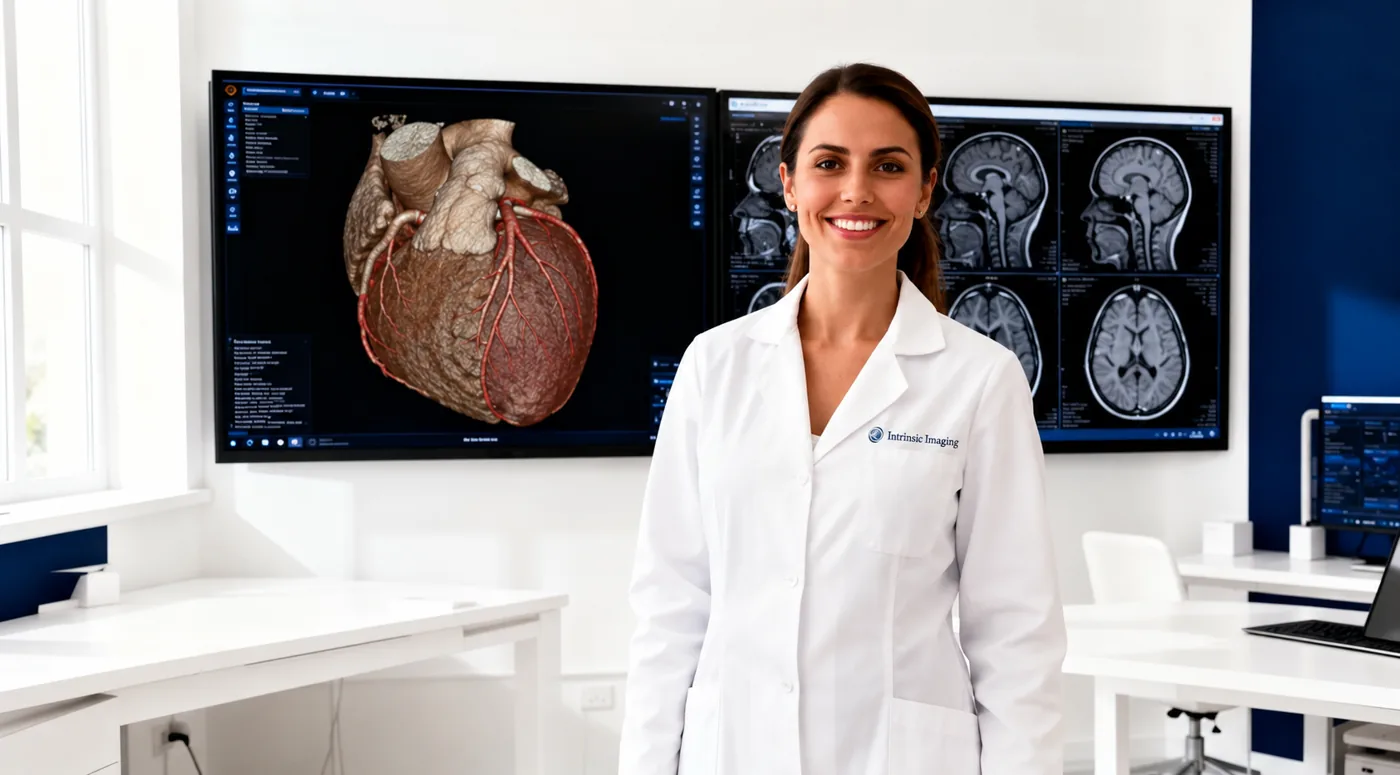
Radiologist reviewing clinical trial imaging in an imaging CRO reading room

Our Imaging Core Lab

How Intrinsic Imaging Standardizes Trial Imaging

Intrinsic Imaging standardizes imaging across the sites, scanners, and technologists of a multicenter clinical trial. Our teams work closely with sponsors and their clinical CROs from protocol development through database lock to develop the imaging charter, qualify and train sites, perform quality control on every examination, conduct blinded independent central review, and deliver reconciled data.

By combining standardized acquisition, independent blinded assessment, and a traceable record, Intrinsic Imaging helps sponsors obtain imaging endpoints that are measured consistently across the study, protected from site-level bias, and documented from the scanner to the dataset. Intrinsic Imaging’s approach is consistent with FDA’s guidance on clinical trial imaging endpoints, which states that a centralized, fully blinded image interpretation process may greatly enhance the credibility of image assessments and better ensure their consistency.

Standardized acquisition

Intrinsic Imaging uses image acquisition guides, scanner qualification, and phantom procedures so that a lesion measured in Boston and a lesion measured in Seoul are measured on comparable images.

Independent, blinded interpretation

Intrinsic Imaging’s reviewers assess images without knowledge of treatment arm, site assessment, or clinical course and apply the assessment criteria defined in the imaging charter.

A traceable record

Every image receipt, query, assessment, adjudication, and data transfer is recorded in Intrinsic Imaging’s validated, 21 CFR Part 11 compliant system, allowing the evidence to be reconstructed during an audit or inspection.

Services

Intrinsic Imaging delivers end-to-end imaging CRO services.

At Intrinsic Imaging, our teams work with sponsors from study kickoff to database lock, in clinical trials of every phase and across all imaging modalities and therapeutic areas. Each of the services below is supported by our technology, software validation, and defined turnaround times, giving sponsors predictable timelines and a traceable record of each study.

Study Management

A designated Intrinsic Imaging project manager and a documented study plan give sponsors a single point of accountability from kickoff to database lock.

Site Training and Management

At Intrinsic Imaging, our site management team qualifies each imaging site and trains its technologists before the first participant is scanned, reducing repeat examinations and non-evaluable images.

Imaging Charter Development

Intrinsic Imaging’s physicians and operations teams write the imaging charter, giving the sponsor, the sites, and the reviewers one prespecified method for each imaging endpoint.

Image Acquisition Guide Development

Study-specific instructions prepared by Intrinsic Imaging show technologists how to perform each examination, keeping images comparable across sites, scanners, and timepoints.

Reviewer Training

Every reviewer is trained and qualified on the imaging charter, and Intrinsic Imaging measures agreement throughout the study to keep assessments consistent among reviewers and over time.

Electronic Case Report Form (eCRF) Development

Intrinsic Imaging designs, builds, and validates an eCRF for each study, giving sponsors complete, consistent assessment data that are ready for analysis.

Image Assessments

Subspecialty reviewers at Intrinsic Imaging perform blinded eligibility, safety, and efficacy assessments with adjudication, limiting bias and variability in each imaging endpoint.

Data Management and Reporting

Intrinsic Imaging tracks every image and assessment, reconciles each dataset before release, and reports study status, allowing sponsors to lock the database on schedule.

Quality Management System

ISO Certified by BSI. Inspected by the FDA.

Intrinsic Imaging has completed three FDA Bioresearch Monitoring Program inspections, covering both medical device and pharmaceutical clinical trials, and each closed with zero Form FDA 483 observations. This record reflects the strength of our quality management system, operational controls, documentation practices, and commitment to data integrity.

Intrinsic Imaging is certified by the British Standards Institution (BSI) and is the only imaging core lab in the world to hold five ISO certifications specifically for imaging core lab services for clinical trials. Together, these standards form one integrated framework governing the processes, technology, personnel, data, and controls that support:

  • Phase I–IV pharmaceutical and biotechnology clinical trials
  • Class I, II, and III medical device trials supporting 510(k), De Novo, and PMA submissions
  • Artificial intelligence and medical imaging software validation studies

By maintaining one certified quality management system across every study, Intrinsic Imaging helps sponsors reduce operational and regulatory risk, protect the integrity of their imaging endpoints, and obtain reliable, audit-ready evidence for the most demanding clinical trials.

FDA Inspected — a record of regulatory excellence.

ISO Certified — a foundation of quality and trust.

Inside Intrinsic Imaging

How Our Imaging Core Lab Works

  1. Imaging charter and review design

    Intrinsic Imaging’s physicians and operations teams develop an imaging charter that defines the imaging schedule, acquisition requirements, assessment criteria, review design, blinding rules, and adjudication triggers before the first participant is scanned. Each later step of the study is checked against the charter, which is typically finalized about 20 business days after study kickoff.

  2. Site qualification and acquisition standardization

    Intrinsic Imaging qualifies each site through an equipment survey, scanner validation, and a test submission, with phantom imaging where the endpoint requires it. Technologists are trained on the image acquisition guide before routine study imaging begins, which reduces acquisition deviations and repeat examinations. The reading system is typically ready, with the first site activated, about 15 business days after contract execution.

  3. Secure image intake and quality control

    Intrinsic Imaging receives images through a secure, DICOM-based process, de-identifies them, assigns each examination to the correct participant, visit, and modality, and checks it for completeness and technical quality against the imaging charter. Receipt is typically confirmed on the same business day, and a quality control result or query is issued within 24 to 48 hours of upload, with each query stating what the site needs to correct. Prompt feedback allows a site to adjust its technique before the next participant is scanned.

  4. Blinded independent central review

    Examinations that pass quality control are assigned to Intrinsic Imaging’s subspecialty reviewers under the single-, double-, or triple-read design defined in the imaging charter. Reviewers work independently within our reading system and see only the information the charter allows, which limits site-level and treatment-related bias in the endpoint.

    Each assessment is recorded on a study-specific eCRF, so that every reviewer captures the same measurements in the same way. Eligibility and safety assessments are typically completed within 24 to 72 hours, and efficacy assessments within 5 to 10 business days of each locked batch.

  5. Quantitative analysis and adjudication

    Intrinsic Imaging performs longitudinal measurements, volumetric analysis, and imaging biomarker analyses under written method specifications with reproducibility checks, giving sponsors quantitative results that can be verified and defended. When reviewers disagree beyond the charter’s discordance rules, Intrinsic Imaging assigns an independent adjudicator to review the images and both assessments, and the audit trail preserves the original assessments alongside the adjudicated result.

  6. Data delivery and regulatory support

    Intrinsic Imaging reconciles each dataset against its source assessments, maps it to the data transfer specification defined with the sponsor, and releases it from our validated, 21 CFR Part 11 compliant system in time for interim analyses, database lock, and regulatory submission. The complete imaging record then supports review by FDA, EMA, and PMDA and any inspection that follows.

Full turnaround expectations for each step
01

Independent Assessment

How Blinded Central Review Protects Your Imaging Endpoints

A controlled review pathway keeps image quality, independent interpretation and endpoint resolution connected—without compromising reader blinding.

Site Images

Protocol-defined acquisition and secure submission.

Intake & Quality Control

Identity, completeness and acquisition checks.

Reader A

Independent, blinded assessment.

Reader B

Independent, blinded assessment.

Assessment Comparison

Apply the charter’s concordance and discordance rules.

Adjudication When Required

Resolve qualifying discordance; concordant assessments proceed directly to reconciliation.

Endpoint Data

Reconciled assessments and traceable data delivery.

Illustrative dual-reader pathway. The imaging charter defines the reader model, blinding rules, discordance criteria and when adjudication is required.

Intrinsic Imaging Builds Each Study Around Your Evidence Requirements

Intrinsic Imaging configures image acquisition, subspecialty review, quantitative analysis, and quality oversight around the evidence each protocol requires.

Anatomic, Functional and Molecular Imaging

Intrinsic Imaging supports CT and MRI morphology, PET and SPECT molecular imaging, cardiac ultrasound, angiography, bone density imaging, retinal imaging, and central endoscopy assessment. Our quantitative methods include diffusion and perfusion MRI, volumetry, liver fat and stiffness measurement, quantitative PET, and radiomics, and Intrinsic Imaging selects the methods for each study according to the protocol and the validation each endpoint requires.

Primary, Secondary, Safety and Exploratory Endpoints

Intrinsic Imaging helps sponsors define how each imaging biomarker will be used and the controls it requires. A primary endpoint and an exploratory radiomics analysis may call for different review designs and levels of validation. Intrinsic Imaging therefore aligns the imaging charter and study plan with the protocol before imaging begins, so that acquisition and assessment support the question each endpoint is intended to answer.

Working With Sponsors and Their Clinical CROs

Intrinsic Imaging works with the sponsor’s clinical operations, data management, and medical monitoring teams and with the clinical CRO. A responsibility matrix established at study startup assigns site communication, query ownership, safety escalation, and data transfers to Intrinsic Imaging, the sponsor, or the clinical CRO, so that every step has a clear owner, each handoff is documented, and the closeout package is agreed in advance.

Study Rescue & Core Lab Transfer

Intrinsic Imaging takes over imaging studies already in progress. Our teams transfer the image archive, align the imaging charter, train subspecialty reviewers on the protocol, and re-engage sites, giving the sponsor a controlled, documented transition that keeps the clinical trial moving.

Rescue my study

Imaging endpoints

Modalities & Response Criteria Matrix

Intrinsic Imaging supports established and protocol-specific assessment criteria across therapeutic areas. The methods used for imaging, endoscopy, histopathology, and functional assessments are selected according to the endpoints of each study.

Therapeutic areaModalitiesResponse criteria & endpoints
OncologyCT, MRI, PET/CT, bone scan
CardiovascularEchocardiography, cardiac MRI, CT angiography, IVUS
LVEFStrain imagingPlaque volumeValvular regurgitation grading
Central Nervous SystemMRI, amyloid & tau PET, DaT-SPECT, CT/CTA
MS lesion burdenVolumetric MRIHippocampal volumetryAmyloid/Tau PETARIA-E/ARIA-HASPECTS
MusculoskeletalX-ray, MRI, DXA, QCT
Sharp/van der HeijdeRAMRISMOAKSWORMSKellgren-LawrenceBone mineral density
GastroenterologyEndoscopy, MR enterography, MRI-PDFF, elastography; separate histopathology
SES-CDMayo endoscopic subscoreUCEISMaRIALiver fat/stiffnessRobarts Histopathology Index
OphthalmologyOCT, fundus photography, fluorescein angiography
Central subfield thicknessGeographic atrophy areaDR severity grading

Global Site Network & Faster Study Startup

Intrinsic Imaging has worked with more than 4,000 imaging centers in 64 countries, and many of the sites selected for a new clinical trial may already know our acquisition guidelines. Our scanner qualification and phantom procedures apply across all major scanner manufacturers, allowing new sites to be qualified and trained quickly and shortening study startup.

Imaging centers worked with
4000+
Countries
64
Board-Certified Physicians
650+
Supporting global trials
Since 2010

Direct physician access

Work Directly With Our Medical Leadership

  • • The sponsor’s medical monitor speaks directly with Intrinsic Imaging’s board-certified physicians, with no intermediary.
  • • Intrinsic Imaging’s physicians help author the imaging charter and resolve discrepancies between reviewers.
  • • Intrinsic Imaging keeps the same leadership team on each study from kickoff to database lock.
Meet Our Leadership

Our reviewer network

Subspecialty Reviewers, Held to One Standard

Intrinsic Imaging selects reviewers for each study from our reviewer network, which includes more than 650 board-certified, fellowship-trained physicians in oncology, cardiovascular and thoracic, central nervous system, gastroenterology and metabolic, musculoskeletal, and ophthalmology imaging. Reviewers are matched to the indication, the modality, and the assessment criteria that each protocol specifies, giving sponsors assessments made by specialists in the disease under study.

Before assessing participant images, each reviewer is trained on the imaging charter and reviewer training manual and must pass study-specific qualification cases. Intrinsic Imaging measures agreement within and between reviewers throughout the study, retrains reviewers when the charter’s threshold is not met, and documents each reviewer’s independence from the sponsor and from participating sites. Sponsors can therefore show that every assessment was made by a qualified, independent reviewer following the prespecified method.

Featured Case Study

Intrinsic Imaging

Oncology

Fast-Track Rare Disease Oncology Trial

  • 40 sites in 14 countries
  • Fewer than 3 patients per site
  • Priority Review program

Challenge

Registration trials in rare diseases face substantial recruitment and operational constraints. With fewer than three patients per site spread across 40 sites in 14 countries, each imaging timepoint contributed materially to the limited dataset, and any delay in central review directly threatened enrollment momentum. The sponsor's expedited development and submission schedule required rapid core lab activation and responsive query resolution without compromising the methodological rigor or documentation of imaging assessments.

Read the case study
View all case studies

Frequently Asked Questions

Who provides medical leadership at Intrinsic Imaging?
Dr. Amit Mehta serves as Executive Vice President, Chief Medical Officer and Co-founder of Intrinsic Imaging. He is a board-certified radiologist and fellowship-trained interventional radiologist who completed diagnostic radiology residency and fellowship training in Minimally Invasive Image-Guided Surgery at Massachusetts General Hospital and Harvard Medical School.
Does Intrinsic Imaging’s news page include independent media coverage?
Yes. Alongside its own announcements, Intrinsic Imaging’s Press Releases and News page links to coverage in publications such as Radiology Business, the San Antonio Report and Startups San Antonio.
Does Intrinsic Imaging support osteoarthritis and rheumatoid arthritis trials?
Yes. Intrinsic Imaging supports osteoarthritis and rheumatoid arthritis trials, including endpoints for joint-space width, cartilage, structural progression and inflammation.
Go to more Frequently Asked Questions

Tell us about your trial.

Discuss imaging CRO services for your clinical trial with Intrinsic Imaging.